ROMO. — Digital Wellbeing App
Problem & Target Users
Exploring how to encourage more conscious smartphone use through self-awareness, reflection, personalized support, and intentional friction, rather than relying exclusively on restrictive digital detox approaches.
My Role
Secondary Research, Concept Development & Feature Ideation (5-Person Team)
Project Type & Context
Academic Design Concept & Prototype · 5-Person Team · 2025
Methods & Key Skills
My Role & Contributions
As part of a five-person team, I contributed across different stages of ROMO., including secondary research, concept development, feature ideation, and design discussions. I was involved in shaping the overall direction of the project, while the final interactive prototype was developed by other team members.
01 The Challenge
Smartphones and social media apps are engineered to capture attention, frequently turning daily engagement into an automatic, unconscious routine. When seeking to regain control, common digital wellbeing interventions often rely exclusively on restrictive digital detox approaches—such as rigid screen-time lockouts or forced app blocking. However, strict abstinence can lead to frustration, rebound scrolling, and social tensions.
ROMO. is an academic digital wellbeing app concept developed by a five-person team. The project explores how to encourage more conscious smartphone use through self-awareness, reflection, personalized support, and intentional friction, rather than relying exclusively on restrictive digital detox approaches. The central challenge lies in navigating the delicate balance between encouraging awareness and respecting autonomy.
Central Design Question
“How might we encourage more intentional smartphone use without taking away users' freedom of choice?”
The project resulted in an exploratory design concept and prototype. Rather than presenting a launched product with proven behavioral effectiveness, ROMO. investigates how thoughtful intentional friction can provide cognitive breathing space for mindful choice.
02 Research & Insights
The research foundation for ROMO. was a literature review addressing smartphone habits, FOMO, digital detox limitations, motivation, and privacy—rather than primary user research or usability testing. This secondary research revealed three core themes:
Habitual smartphone use
Smartphone engagement can become automatic, and users may not accurately perceive their smartphone habits. Unconscious scrolling loops often occur without deliberate intention.
Digital detox and FOMO
Strict abstinence may be difficult to sustain and can create social or emotional tensions, including anxiety tied to FOMO and social disconnection.
Autonomy and privacy
Wellbeing interventions should consider personal motivation, meaningful choice, and responsible data use, prioritizing user autonomy and avoiding paternalistic enforcement or intrusive monitoring.
Conceptual Translation
From Insights to Design
We connected these research themes directly to proposed design features. The following describe design rationale and intentions rather than validated behavioral outcomes:
Reflecting on Everyday Habits
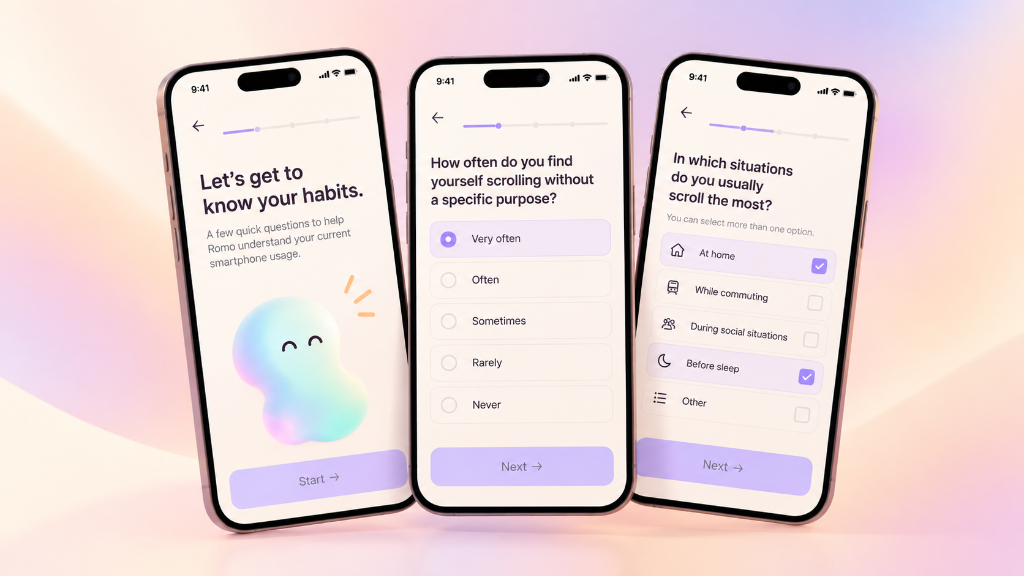
The onboarding quiz invites users to reflect on their screen-time habits, helping them articulate personal patterns before configuring app settings.
Encourage self-awareness rather than imposing arbitrary numeric restrictions.
Creating a Moment of Choice
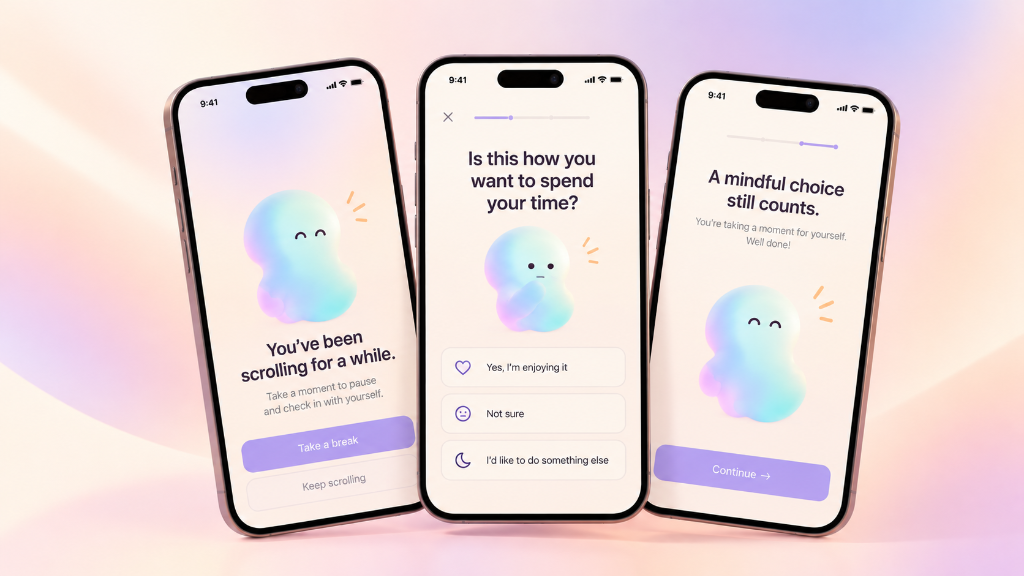
Reflective notifications and interruption prompts are intended to create a moment of conscious choice before continued use, pausing mindless scrolling loops.
Introduce respectful pauses while keeping users in control of their actions.
Flexible, User-Defined Support
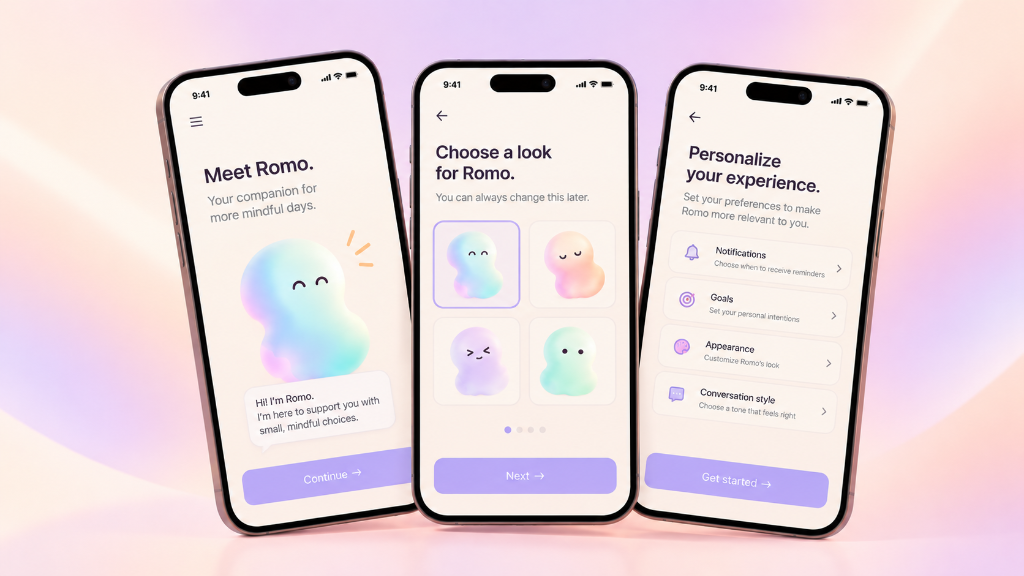
Customizable goals and intervention settings aim to avoid imposing a single restrictive experience on every user, respecting individual routines and priorities.
Support individual agency with adaptable personalization preferences.
* Note: These are design intentions derived from published academic literature, not findings from user interviews, surveys, or usability testing.
03 The Solution
A concept exploring mindful pauses, personalized support, and self-awareness.
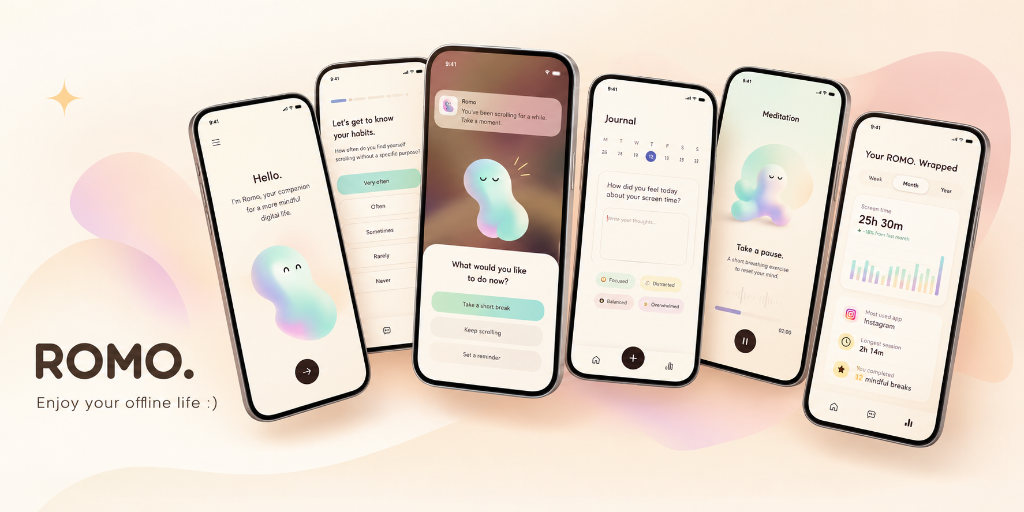
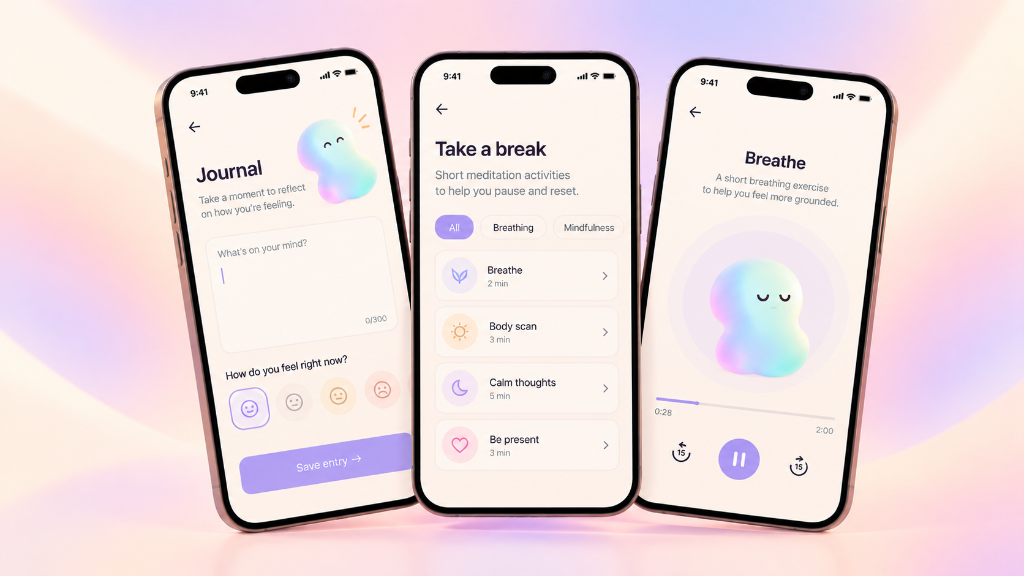
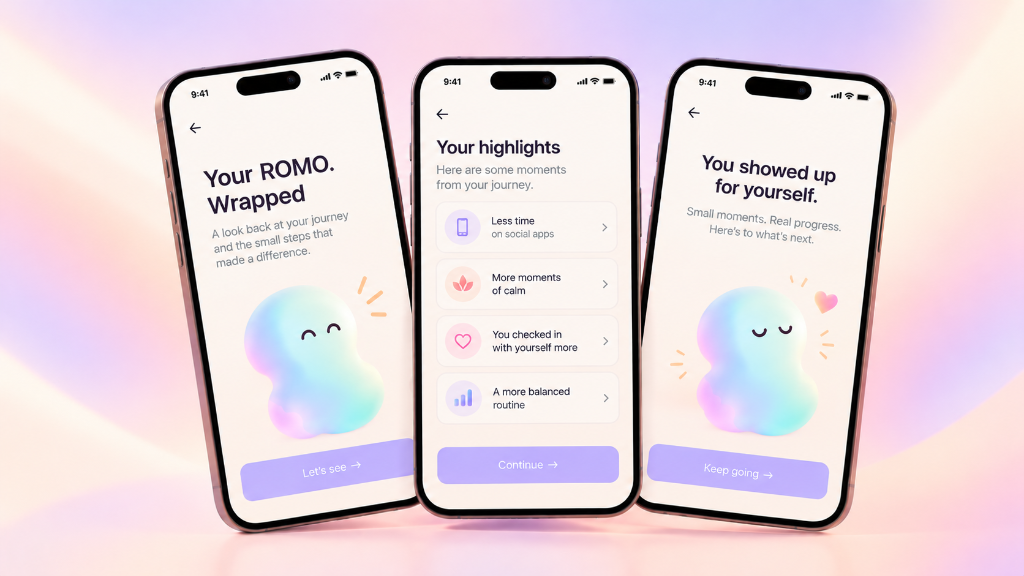
ROMO. is presented through the design features already featured on the website—including reflective onboarding, intentional friction prompts, personalized companion support, and usage awareness summaries. The interactive carousel below illustrates these concept directions. Note that this represents an academic design concept and prototype, and not every proposed feature was fully implemented or deployed.
04 Trade-offs & Limitations
Designing for digital wellbeing surfaces genuine tensions between behavioral encouragement and individual freedom. Because ROMO. remained an academic concept and prototype without longitudinal field testing, several key trade-offs and limitations should be recognized:
Sustaining Long-Term Motivation
While intentional friction and reflective prompts can create moments of conscious choice in the short term, sustaining long-term motivation over months remains a major challenge. Without longitudinal behavioral research, it is uncertain whether users would continue to engage thoughtfully or eventually experience prompt fatigue.
Ethical Implications of Monitoring Activity
Triggering timely friction requires monitoring smartphone activity, which introduces ethical tensions around surveillance, guilt, and paternalism. Balancing supportive awareness with the user's right to unmonitored user autonomy is an ongoing design challenge that was not empirically resolved.
Data Minimization and Privacy
Respecting privacy requires strict data minimization and privacy safeguards—focusing on high-level screen durations rather than detailed in-app behavior or communication logs. Within a prototype exploration, technical safeguards and on-device privacy protections were conceptual rather than fully implemented or security-audited.
Not a Replacement for Psychological Support
Excessive screen time and compulsive digital habits often intersect with deeper emotional and psychological factors. It is critical that digital wellbeing apps are not positioned as replacements for psychological support; ROMO. was conceived strictly as an interface exploration for everyday habit reflection.
05 Reflection & Learnings
Working on ROMO. helped me understand how psychological research can inform design decisions without offering simple answers. I learned to think more critically about the balance between supporting behavior change and respecting people's autonomy. Collaborating across different stages of the project also showed me the importance of discussing trade-offs early, rather than treating them as problems to solve only at the end.